

Science & Nature
MediumThe Fungi Forest Crossword
Category: Science & NatureDifficulty: Medium12 × 12
Wednesday, November 18
Enter one letter per square. Answers run Across or Down. Omit spaces and accents; any special spelling convention is stated in the clue. This is a freeform themed grid, so some letters are not crossed.

About This Theme
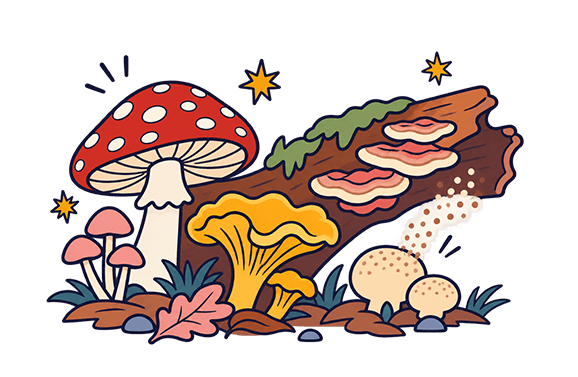
A mushroom is often the most visible sign of a much less visible organism. Beneath bark, within soil, or through a food source, fine threads can form an extensive living network. This puzzle explores fungal structures and relationships rather than identifying edible species. Look for distinctions between a single thread and a network, or between a reproductive structure and the organism that produces it. Fungi do not all look like capped mushrooms, and their role in a landscape can include decomposition, partnership, and interactions with other living things. Mycelium — Mycelium; What is a lichen? - Lichen website — Lichen

Clues
Across
- 2Small reproductive unit released by many fungi (5)
- 6Association dominated by a fungus with an alga or cyanobacterium partner (6)
- 7Upper umbrella-like part of many mushrooms (3)
- 8Thin plates beneath the caps of many mushrooms (5)
- 9Technical term for a mushroom's stalk (5)
- 11Association between a fungus and a plant's roots (10)
Down
- 1Organism that helps break down dead organic material (10)
- 3A single threadlike filament of a fungus (5)
- 4Network of branching fungal threads (8)
- 5Fungus that commonly grows as individual cells and is used in bread-making (5)
- 7Structural substance found in fungal cell walls (6)
- 10Filamentous fungal growth commonly seen on spoiled food; US spelling (4)
Answers and Explanations
After Your Solve
A mushroom is a fruiting body, not a complete picture of the fungus. The mycelium can remain out of sight while obtaining nutrients from its surroundings. Some fungi break down dead material; others form relationships with living organisms. Lichens illustrate association with a photosynthetic partner, while mycorrhizae involve plant roots. Those relationships are not interchangeable. Understanding the vocabulary helps describe what a fungus is doing without drawing conclusions about whether an unfamiliar mushroom is safe to eat. Mycelium — Mycelium; What is a lichen? - Lichen website — Lichen; Mycorrhiza — Fungus-root partnerships
- 2 acrossSPORE
Spores can disperse and begin new growth under suitable conditions. They are not seeds, even though both can play roles in reproduction and movement to new locations. What is a fungus ? — Spore
- 6 acrossLICHEN
A lichen includes a fungal partner and a photosynthetic partner. Their association differs from a mushroom simply growing beside a plant on the forest floor. What is a lichen? - Lichen website — Lichen
- 7 acrossCAP
The cap is the upper part of a typical mushroom, often with gills beneath it. That familiar arrangement describes one fungal form, rather than a feature of every fungus. What is a fungus ? — Cap
- 8 acrossGILLS
Gills provide surfaces on which spores are produced in many mushrooms. Other fungi use pores or different structures, so gills are not universal to all mushroom forms. What is a fungus ? — Gills
- 9 acrossSTIPE
A stipe supports the cap in many mushrooms. Using the technical word avoids confusing this fungal structure with the stem of a vascular plant. Merriam-Webster — Stipe
- 11 acrossMYCORRHIZA
A mycorrhiza involves fungal and root partners exchanging resources. It is distinct from a lichen, whose photosynthetic partner is an alga or cyanobacterium. Mycorrhiza — Fungus-root partnerships
- 1 downDECOMPOSER
A decomposer breaks down dead organic material and returns its constituents to ecological cycles. Many fungi fill that role, alongside other organisms such as bacteria. Merriam-Webster — Decomposer
- 3 downHYPHA
A hypha is one filament; hyphae is the plural. Distinguishing it from the whole mycelium is like distinguishing one branching element from the network it helps form. Mycelium — Hypha
- 4 downMYCELIUM
Mycelium is the network formed by many hyphae. It can spread through a substrate without producing a visible mushroom at every point or at every time of year. Mycelium — Mycelium
- 5 downYEAST
Yeasts demonstrate that fungi need not form visible mushrooms. Some carry out fermentation useful in food production, but yeast describes a growth form rather than one single species. Mycelium — Hyphal growth and single-celled yeasts
- 7 downCHITIN
Chitin contributes to fungal cell walls and also occurs in arthropod exoskeletons. Its presence helps distinguish fungal cell-wall composition from the cellulose-rich walls familiar in plants. Mycelium — Chitin
- 10 downMOLD
Molds grow through branching filaments and can produce visible colonies. The everyday label describes a form of fungal growth rather than one uniquely defined species. Mycelium — Hyphal growth and single-celled yeasts
Further Reading
- Mycelium — Myceliumanbg.gov.au
- What is a lichen? - Lichen website — Lichenanbg.gov.au
- Mycorrhiza — Fungus-root partnershipsanbg.gov.au
About Eric Allred
Puzzle writing, factual review and editorial direction
Eric Allred started Triviosity after seeing how much his dad and his dad's partner enjoyed morning trivia on their iPad. A board-game fan since childhood, he brings several years of experience building a performance marketing agency to the solver experience. Eric is responsible for puzzle writing, factual review and editorial decisions, and reviews puzzles with AI assistance after they are created.
More about Eric AllredSuggest a correctionMore Puzzles
Science & Nature
HardSpace Crossword: Early Spaceflight
Play Space Crossword: Early Spaceflight

Keep a little curiosity in your inbox
Join the Triviosity newsletter for puzzle links and new themes. You can unsubscribe at any time.